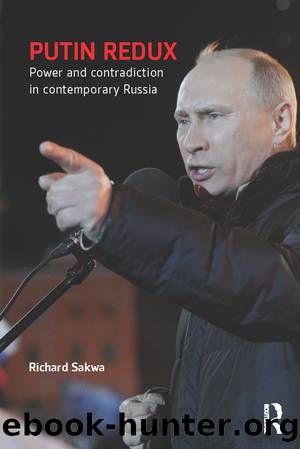
Putin Redux: Power and Contradiction in Contemporary Russia by Richard Sakwa
Author:Richard Sakwa [Sakwa, Richard]
Language: eng
Format: epub
Tags: General, Biography & Autobiography, Presidents & Heads of State, Political Science
ISBN: 9781317704294
Google: 3d2hAwAAQBAJ
Goodreads: 22482968
Publisher: Routledge
Published: 2014-05-23T00:00:00+00:00
The protest movement was far from representing a âRussian Springâ, let alone a âsnow revolutionâ, although it was sometimes seen as a continuation of the events in North Africa. Putinâs Russia was not a consolidated authoritarian regime of the likes of Egypt, where there had been some 30 years of repression in the framework of a state of emergency. Instead, the election revealed the contradictions of the Russian dual state. Hesitant to embrace full-blooded authoritarianism, the regime was forced to make concessions through the liberalisation of the political system and the strengthening of the impartial institutions of the constitutional state, notably free, fair and transparent elections.
Just four days after the vote, as popular revulsion against the manipulations gathered force and the mass arrest of demonstrators, Putin typically insisted that the turbulence was the result of outside forces, notably the American foreign minister Hillary Clinton: âFrom the outset the secretary of state said that [the elections] were not honest and not fair, but she had not yet even received the material from the observers. She set the tone for some actors in our country and gave them a signal. They heard the signal and with the support of the US State Department set to work.â He went on to note that âWe are the largest nuclear power, and our partners have certain concerns and shake us so that we donât forget who is the master of this planet, so that we remain obedient and feel that they have leverage to influence us within our own country.â21 He warned that those who âdance to the tune of a foreign stateâ would be held to account. His minions heard Putinâs signal, unleashing a vicious anti-American campaign that soon targeted NGOs funded by western agencies, and provoked the nasty harassment of the new American ambassador, Michael McFaul, who as one of his first acts met with civil society activists in an event long planned by his predecessor.22
Putin had never really bought into the âresetâ in Russo-American relations, considering the US an unscrupulous and untrustworthy actor with whom it was impossible to have a mutually advantageous relationship. Specific deals could be done, but there could be no serious prospect of a âpartnershipâ. The relapse of the relationship into the anachronistic nuclear disarmament agenda, which gave rise to the New Start treaty in 2010, demonstrated the shallow foundations of the relationship. Bitter experience, including the establishment of the Eastern Partnership (EaP) in May 2009, seems to have led him to much the same view of the European Union. Worse, hardliners in his entourage nurtured similar suspicions about Medvedev, who they argued had mismanaged affairs and encouraged the protesters. Once back in the Kremlin, elements in Putinâs administration waged a cold war against their own prime minister; organising leaks, investigations and smears that paralysed the work of the cabinet.
In his question and answer âdirect lineâ session on 15 December Putin was laconically contemptuous of the protesters who had gathered on Bolotnaya Square on 10 December with white ribbons on their lapels, the symbol of the desire for free and fair elections.
Download
This site does not store any files on its server. We only index and link to content provided by other sites. Please contact the content providers to delete copyright contents if any and email us, we'll remove relevant links or contents immediately.
| Arms Control | Diplomacy |
| Security | Trades & Tariffs |
| Treaties | African |
| Asian | Australian & Oceanian |
| Canadian | Caribbean & Latin American |
| European | Middle Eastern |
| Russian & Former Soviet Union |
The Secret History by Donna Tartt(19086)
The Social Justice Warrior Handbook by Lisa De Pasquale(12190)
Thirteen Reasons Why by Jay Asher(8909)
This Is How You Lose Her by Junot Diaz(6886)
Weapons of Math Destruction by Cathy O'Neil(6279)
Zero to One by Peter Thiel(5801)
Beartown by Fredrik Backman(5754)
The Myth of the Strong Leader by Archie Brown(5507)
The Fire Next Time by James Baldwin(5442)
How Democracies Die by Steven Levitsky & Daniel Ziblatt(5218)
Promise Me, Dad by Joe Biden(5153)
Stone's Rules by Roger Stone(5087)
A Higher Loyalty: Truth, Lies, and Leadership by James Comey(4962)
100 Deadly Skills by Clint Emerson(4925)
Rise and Kill First by Ronen Bergman(4788)
Secrecy World by Jake Bernstein(4753)
The David Icke Guide to the Global Conspiracy (and how to end it) by David Icke(4717)
The Farm by Tom Rob Smith(4507)
The Doomsday Machine by Daniel Ellsberg(4490)
